Qandai - AI-powered platform automating RFP/RFI responses in regulated industries
Founded in 2021 (pre-ChatGPT), Qandai tackled the persistent problem of manually completing lengthy questionnaires in Life Sciences and Financial Services through AI automation, browser extensions, and Office integrations.
- Startup
- Qandai
- Year
- Service
- Founder, Product Development, AI Architecture
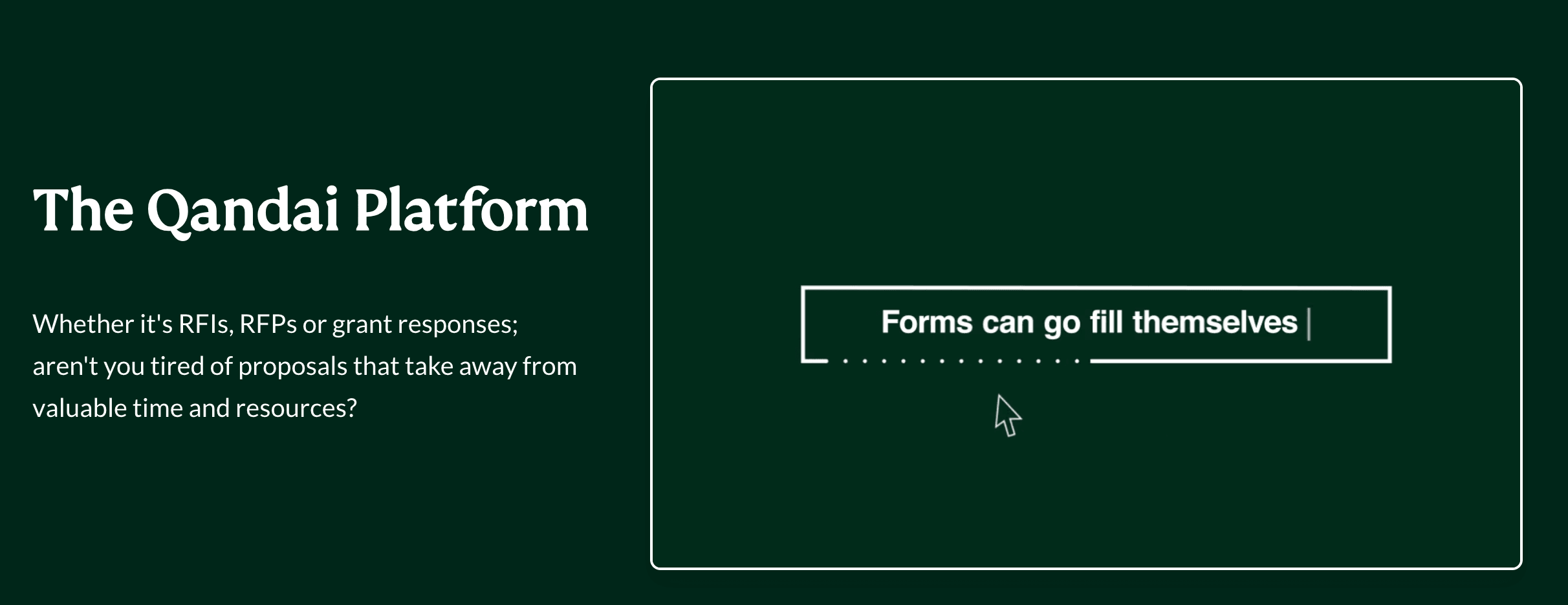
Overview
Qandai was founded in February 2021 to solve a problem I'd witnessed repeatedly while consulting in regulatory environments: the manual, time-consuming process of completing lengthy questionnaires for RFPs and RFIs in Life Sciences and Financial Services. This was before ChatGPT existed—AI was promising but required significant engineering to apply to real-world document workflows.
The platform automated questionnaire completion through multiple channels: a web application, Chrome extension for online forms, and bespoke Microsoft Word and Excel add-ins. Deployed across Europe and the US on AWS infrastructure, with integrations to Google Sheets for data management.
Qandai was an end-to-end entrepreneurial experience: securing UK trademark rights, acquiring paying customers, building and evolving technical architecture as the AI landscape shifted rapidly beneath us, and running all aspects of a startup from product to operations.
The Challenge
Regulated industries face a constant stream of questionnaires: RFPs from potential clients, RFIs from regulators, compliance assessments, vendor evaluations. These documents are often 50-200 pages long with hundreds of questions. Completing them manually is tedious, error-prone, and creates inconsistencies when similar questions are answered differently across submissions.
Existing solutions were either basic mail-merge tools or expensive enterprise content management systems that required months of implementation. There was a gap for intelligent automation that could understand question context, retrieve relevant previous answers, and adapt responses while maintaining compliance standards.
Building this pre-ChatGPT meant working with earlier generation AI models that required more sophisticated prompt engineering and domain-specific tuning. The challenge wasn't just technical—it was entrepreneurial: validating market need, acquiring customers in risk-averse industries, and building a sustainable business.
My Role
As Founder, I owned everything: product vision, technical architecture, customer acquisition, fundraising conversations, trademark registration, compliance considerations, and day-to-day operations. This was a masterclass in running a startup from conception to paying customers.
Product Strategy & Market Validation
Challenge
Validate that AI automation for questionnaires was a problem worth solving in regulated industries, identify the right distribution channels, and acquire early customers without a large sales team.
Contribution
- Leveraged consulting experience to identify Life Sciences and Financial Services as high-value markets with acute pain points
- Designed product positioning that emphasized compliance and audit trails—critical for regulated environments—not just speed
- Built multiple access points (web app, Chrome extension, Office add-ins) to meet users where they work
- Secured UK trademark rights and established legal entity to operate professionally from day one
- Directly engaged prospects, conducted customer development interviews, and closed initial customers personally
Outcome
Validated product-market fit with paying customers in regulated industries. The multi-channel approach proved essential—different teams preferred different workflows (some in Word, others completing forms online). Positioning around compliance rather than pure automation resonated strongly with risk-averse buyers.
AI Architecture & Technical Evolution
Challenge
Build an AI pipeline that could understand diverse questionnaire formats, retrieve relevant context, and generate appropriate responses—all before ChatGPT existed. Then, adapt rapidly as new AI models emerged and fundamentally changed what was possible.
Contribution
- Architected initial AI pipeline using pre-GPT-3.5 models, requiring significant prompt engineering and fine-tuning
- Built question understanding and classification system to route queries to relevant knowledge bases
- Implemented retrieval-augmented generation (RAG) patterns before they had that name—combining semantic search with generation
- Redesigned architecture multiple times as GPT-3.5, GPT-4, and other models became available, each requiring evaluation and integration decisions
- Created robust evaluation frameworks to measure answer quality, relevance, and compliance appropriateness across model versions
Outcome
A continuously evolving AI platform that improved dramatically as the landscape matured. Early architectural decisions around modularity enabled rapid model swapping without full rewrites. The experience of navigating this evolution became a competitive advantage—understanding not just current AI capabilities, but how to architect for continuous AI improvement.
Platform Development & Integrations
Challenge
Build a platform that integrates into existing enterprise workflows across multiple applications (web browsers, Microsoft Office, Google Sheets) while maintaining security and performance standards for regulated industries.
Contribution
- Developed web application as central hub for questionnaire management and knowledge base curation
- Built Chrome extension for capturing and completing online questionnaires directly in the browser
- Created bespoke Microsoft Word and Excel add-ins allowing users to work within familiar Office environments
- Integrated Google Sheets for collaborative data management and answer review workflows
- Deployed multi-region architecture on AWS (Europe and US) to meet data residency requirements for regulated industries
- Implemented comprehensive audit trails and version control—essential for compliance documentation
Outcome
A versatile platform meeting enterprises where they already work. The Office add-ins proved particularly valuable for Legal and Compliance teams who lived in Word documents. Multi-region deployment opened opportunities in EU markets with strict data sovereignty requirements.
Entrepreneurial Execution
Challenge
Navigate all aspects of startup operations: legal entity formation, intellectual property protection, customer contracts, pricing strategy, support, and financial management—while building product.
Contribution
- Secured UK trademark rights to protect brand and intellectual property
- Negotiated customer contracts in regulated industries with stringent security and compliance requirements
- Managed AWS infrastructure costs to maintain profitability at early scale
- Provided customer support and training, gathering product feedback directly from users
- Balanced product development velocity with operational sustainability
Outcome
A functioning startup with paying customers, protected IP, and operational infrastructure. This hands-on experience across all startup functions proved invaluable—understanding not just how to build products, but how to build businesses around them.
Impact & Results
- of rich AI experience
- 4 years
- Paying customers in regulated industries
- Multiple
- Architecture iterations as markets evolved
- 5+
Product Achievements
- Launched multi-channel platform (web, Chrome, Word, Excel) serving regulated industries
- Achieved meaningful time savings for customers (days reduced to hours for complex questionnaires)
- Built and maintained multi-region infrastructure meeting data residency requirements
- Created comprehensive audit trail functionality required for compliance environments
Entrepreneurial Learning
- Validated product-market fit in risk-averse regulated industries
- Acquired paying enterprise customers through direct sales and product-led growth
- Navigated intellectual property protection (trademark), legal entity formation, and contract negotiations
- Built sustainable operations balancing technical ambition with business viability
Technical Evolution
- Architected for continuous AI model evolution—system survived multiple generational shifts in underlying AI capabilities
- Gained deep experience in RAG patterns, prompt engineering, and AI evaluation before these became standard practice
- Understood first-hand how rapidly changing AI landscapes impact architectural decisions and competitive dynamics
Key Learnings
Building Before the Hype
Starting Qandai before ChatGPT meant building with less powerful but more controllable AI. This forced deeper understanding of fundamentals: retrieval strategies, prompt design, evaluation frameworks. When GPT-3.5 and GPT-4 arrived, we could leverage them immediately because the architectural foundations were sound. Sometimes being early means learning the hard way—but those lessons compound.
Architecture for AI Evolution
The AI landscape changed dramatically multiple times during Qandai's life. The key technical learning: design systems that are model-agnostic and evaluation-centric. Don't marry your architecture to a specific model's capabilities—build abstraction layers that enable rapid experimentation and swapping. Invest heavily in evaluation frameworks that let you objectively compare options as new models emerge.
Regulated Industries Require Different Selling
Life Sciences and Financial Services don't buy on speed alone—they buy on trust, auditability, and risk mitigation. The positioning shift from "respond faster" to "respond consistently with full audit trails" was critical. Feature development prioritized compliance requirements (version control, approval workflows, audit logs) as much as AI capabilities. Understanding your customer's risk profile shapes everything.
Multi-Channel Distribution is Operationally Complex
Building Chrome extensions, Office add-ins, and web apps simultaneously created user delight but operational complexity. Each platform has different update cadences, security reviews, and distribution challenges. The learning: focus first on the channel with highest product-market fit, then expand. We probably should have picked one integration and nailed it before building three.
Entrepreneurship is a Full-Stack Discipline
Running Qandai required being comfortable with trademark law, customer contract negotiations, AWS cost optimization, sales conversations, product roadmaps, and architectural decisions in the same week. The startup demanded fluency across business, legal, financial, and technical domains. This breadth proved invaluable—understanding how technical decisions impact business outcomes and vice versa.